


The New York Times interviewed our founder, Jennifer Miller, on FDA Commissioner Dr. Scott Gottlieb's clinical trial transparency initiatives. She discussed his new pilot, launched last month, which selects 9 recently-approved drugs, whose sponsors (generally pharmaceutical companies) volunteer to participate, to post portions of Clinical Study Reports (CSRs) from their pivotal trials on FDA's website… Read More
February 12, 2018

This week we focused on the ethics of Big Data, publishing an article titled, Big Data Probably Knows More About You Than Your Friends Do, in Leaps Mag. The article discusses the promises and perils of big data and concludes with a way to manage your data wealth. To read the full article click here. Read More
February 7, 2018

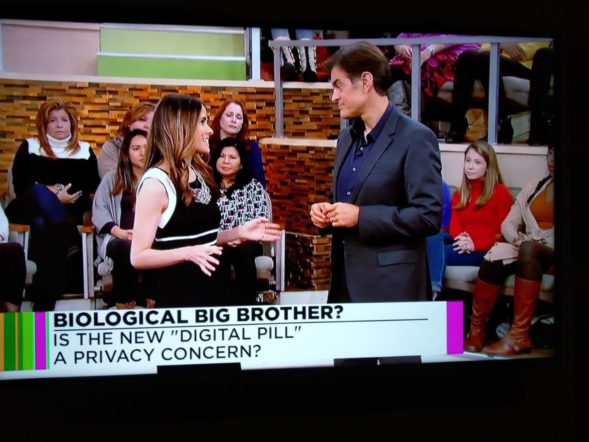
Today, the Dr. Oz Show discussed the 1st FDA approved digital pill, Abilify MyCite. The pill has a sensor to digitally track if patients take their medicines. Our Founder, Jennifer Miller, raised 4 ethics concerns about the new technology on the show. See the clip, here. First, medication adherence is complex. It involves more than just… Read More
January 29, 2018
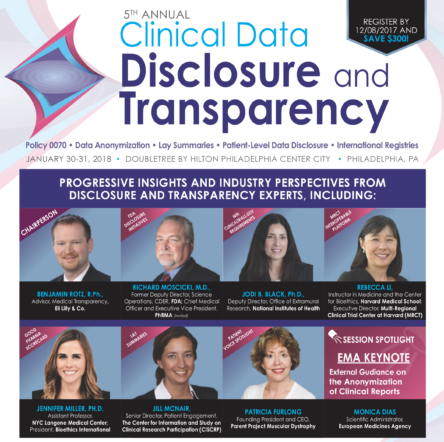
This week, our President, Jennifer Miller, PhD, will speak at CBI's Clinical Data and Disclosure Conference, which starts tomorrow. She will review the 2017 drug and company rankings as well as introduce the new data-sharing standards to be added to the next Good Pharma Scorecard. For more information see our events page. Read More
January 29, 2018
Bioethics International will host a webinar on data-sharing for clinical trials, on February 7, 2018. We will introduce our revised patient-level data-sharing standards to be added to the Good Pharma Scorecard (GPS). We'll also review key feedback from industry and non industry on our previous draft standards. This webinar is mainly for pharmaceutical and biotechnology… Read More
January 4, 2018

We published our 2017 Good Pharma Scorecard Rankings on December 5th in BMJ open. The Scorecard shows meaningful progress has been made on several key transparency metrics since the first Scorecard was released in 2015: the proportion of new drugs with all phase 2 or 3 trials disclosed from their NDAs went up from 50%… Read More
December 19, 2017
Today, our Founder, Dr. Jennifer E. Miller, filmed a segment for the Dr. OZ show on the ethics of the first FDA approved Digital Pill: Abilify MyCite. She discussed how medicine adherence is more complex than just tracking whether a person swallows a pill. Drug costs, whether a patient has transportation to a pharmacy, and even… Read More
December 1, 2017
This week at Bioethics International, we: Participated in the World Economic Forum (WEF) in Dubai. Our Founder, Dr. Jennifer Miller, was appointed to the WEF's Futures Council. She gave a speech on the ethics of human augmentation. We designed new badges, for companies that score #1 or in the top 5 of the Good Pharma Scorecard.… Read More
November 20, 2017

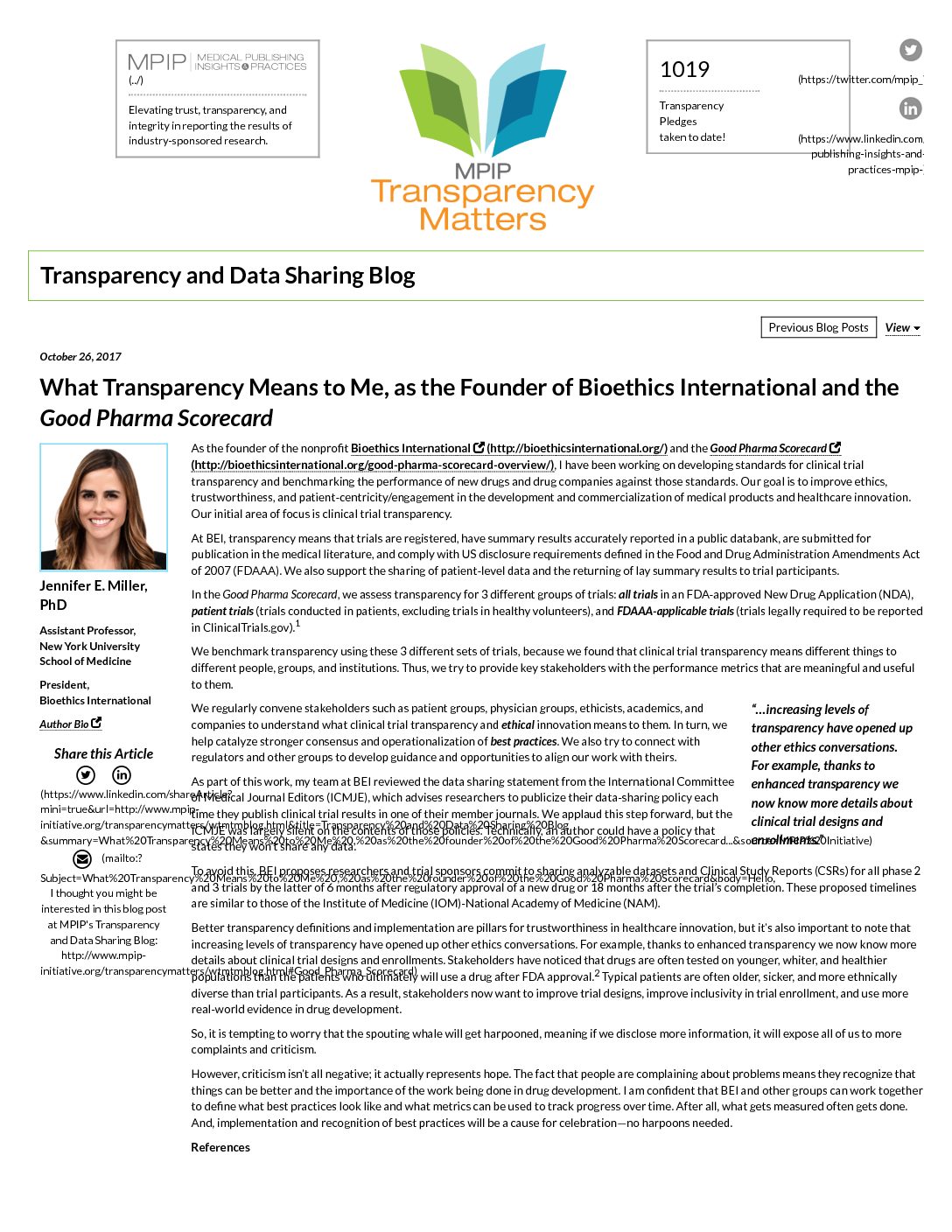
As the founder of the nonprofit Bioethics International and the Good Pharma Scorecard, I have been working on developing standards for clinical trial transparency and benchmarking the performance of new drugs and drug companies against those standards. Our goal is to improve ethics, trustworthiness, and patient-centricity/engagement in the development and commercialization of medical products and… Read More
October 26, 2017
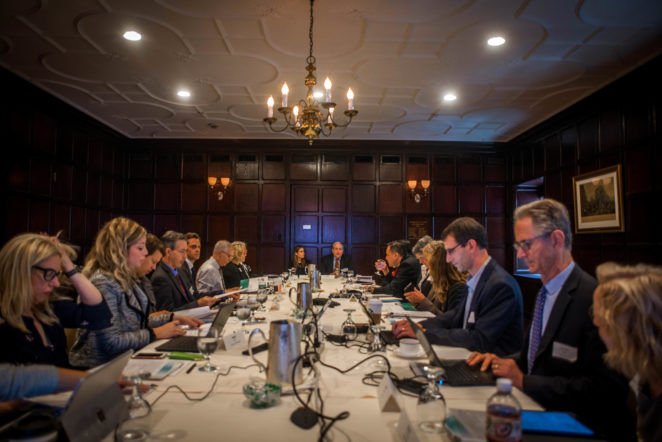
The Patient Roundtable convened patient groups to discuss their key ethics concerns about the pharmaceutical industry and how they define patient-centricity and trustworthiness for the sector. We aim to produce a catalogue of ethics concerns and corresponding standards that may help address perceived problems. Discussions topics include (1) how clinical trials are designed, (2) inclusivity… Read More
October 17, 2017
Bioethics International's top 5 accomplishments this week; we... ...began inviting patient groups to our Patient Roundtable on ethics, trustworthiness and patient-centeredness in pharma to be held in October at the Harvard Club. ...formed and convened our 2018 multi multistakeholder conference planning committee, which includes representatives from Ernst and Young and Scientific American. ...published the results of our study in… Read More
June 26, 2017
Bioethics International's top 5 accomplishments this week, include: Submitting our 2017 Good Pharma Scorecard (GPS) rankings for review by a medical journal. The 2017 rankings include a new company ranking to accompany the drug rankings on clinical trial transparency. We also significantly expanded and refined our methodology since the Harvard Pilot (published in November of 2015… Read More
June 1, 2017
BEI is returning to its roots and blogging again. BEI started as a blog in 2005, called Ethics Illustrated. We'll kick off our blogging with regular updates on our efforts. This month, we've been: Finishing the clinical trial transparency rankings of drugs approved by the FDA in 2014 and large drug companies. We held our bi-annual meeting with the 25 largest drug companies,… Read More
May 18, 2017